
MBBS · PMDC Registered · Irish Medical Council Registered · Aesthetic Physician
Rawalpindi / Islamabad · Last updated: May 2026
Mole Removal Treatment: A Complete Doctor’s Guide to Safe Options
Almost everyone has at least one mole. Most adults have between 10 and 40 skin moles by their thirties. Most of them are harmless. Some are loved as a feature. Others bother people for years until they finally decide to do something about it. If you have arrived at this page, you are probably somewhere in that last group, and the question on your mind is: what are my actual options?
As a practising Aesthetic Physician based in Bahria Town Phase 8, Rawalpindi, I treat moles every week. This guide is the complete picture: what moles actually are, the different types I see, when removal is a good idea, the methods that work, what happens during a consultation, and what to expect afterwards.
What is a mole?
A mole, called a nevus in medical language, is a cluster of melanocytes. Melanocytes are the cells that give your skin its colour. When they group together, they form a small spot of concentrated pigment. On Pakistani skin, which is naturally rich in melanin, moles are common and often visible from a distance. The presence of moles, by itself, does not mean anything is wrong.
The different types of skin moles I see in clinic
Flat moles (junctional nevi)
These sit flush with the skin and feel completely smooth to the touch. They are usually small, round, and dark brown to black. Flat moles respond very well to laser ablation in most cases.
Raised moles (intradermal nevi)
These stand up from the skin like a small dome. They are often flesh-coloured or light brown. They tend to catch on clothing, jewellery, and razors, which is why people often want them removed for comfort. Radiofrequency removal usually works very well for these.
Compound moles
These have features of both flat and raised moles. Removal method depends on size and depth.
Congenital moles
These are present from birth. Most are small and harmless, but larger congenital moles need to be monitored over time. Removal is usually surgical.
Hairy moles
A mole with one or more hairs growing from it is completely normal. Pulling these hairs is the single most common cause of mole infection I see in clinic, so please use blunt-tipped scissors to trim them instead.
Skin tags and warts
Patients often refer to these as moles, but they are different growths. Skin tags are soft, flesh-coloured, and hang off the skin. Warts are rough, raised, and caused by a virus. Both can be removed at the clinic but require different assessments.
Why people choose mole removal
- Cosmetic. The mole is in a visible place and the patient simply does not want it there anymore. This is a completely valid reason and the most common one.
- Medical. The mole has changed in size, shape, or colour, or it has become infected or bleeds repeatedly.
- Comfort. The mole catches on clothing, bra straps, or razors and causes daily irritation.
- Peace of mind. A mole the patient wants checked and removed so they can stop worrying about it.
Should this mole come off? A simple decision framework
Question 1. Has it changed? Use the ABCDE rule. Asymmetry, Border irregularity, Colour variation, Diameter over 6 millimetres, or Evolving size or shape over weeks or months. If you tick any of these, please book a medical assessment.
Question 2. Is it causing problems? Pain, redness, discharge, or signs of infection are reasons to be seen quickly. For more on this, please see my detailed guide on infected mole treatment and warning signs.
Question 3. Does it bother you? If the mole is on your face and you have spent years wishing it was not there, that is a perfectly valid reason to consider removal. For everything about cosmetic facial mole removal, see my detailed guide on black moles on the face.
The mole removal methods we use
There is no single best method for skin moles treatment. The right one depends entirely on what the mole looks like, where it is, how deep it goes, and what kind of result you want.
Laser ablation
Using a focused CO2 or Erbium laser, the mole is vaporised layer by layer with very precise depth control. Excellent for small to medium flat or slightly raised pigmented moles, especially on the face.
Surgical excision
Under local anaesthetic, the mole is cut out with a scalpel and the skin is closed with very fine stitches. The right choice for larger moles, deeper moles, and any mole where I want to send tissue for histopathology.
Radiofrequency removal
A high-frequency electrical current gently shaves off raised moles flush with the skin. Best for flesh-coloured or lightly pigmented raised moles where deep removal is not required.
Methods to avoid completely
- Mole removal creams sold online. They are caustic acids that damage healthy skin.
- Apple cider vinegar, garlic paste, or lemon juice. These cause chemical burns.
- Tying thread or hair around a mole. Causes infection and unpredictable scarring.
- Cutting it off yourself. Risks serious infection, bad scarring, and discards tissue a pathologist may have wanted to examine.
- Removal at a beauty parlour or salon. Mole removal is a medical procedure that must be performed by a registered doctor.
What happens at a mole removal consultation
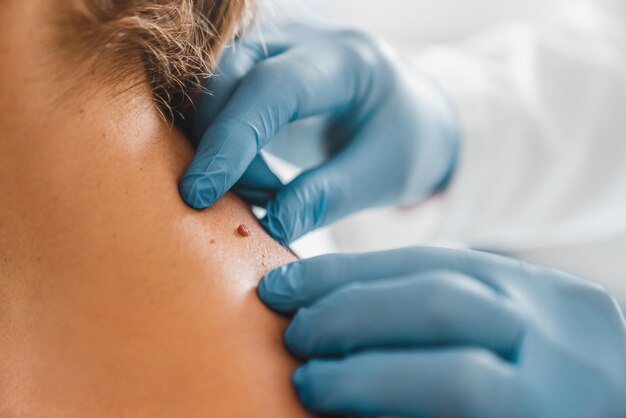
We start with a careful examination of the mole, often using a dermatoscope. I will ask about how long you have had it, whether it has changed, whether it has ever bled, your medical history, and what you are hoping the outcome will look like.
If the mole shows any feature that warrants medical assessment first, I will tell you. If it is straightforward and you wish to proceed, we discuss which removal method will give the best result and I confirm the all-inclusive price in writing before any procedure begins.
What removal actually feels like
A topical anaesthetic cream is applied first, followed by a small injection of local anaesthetic. The injection is the only briefly uncomfortable part. After that, you feel pressure but no pain. The procedure itself takes five to twenty minutes. You go home the same day and can return to work and normal light activities immediately.
Aftercare and recovery
- Keep the area clean and dry for the first few days.
- A small scab will form. Let it fall off on its own.
- Avoid direct sun on the healing area for at least three months and use sunscreen daily. Pakistani skin is prone to post-inflammatory hyperpigmentation, so this step is non-negotiable.
- Avoid swimming pools and steam baths for the first two weeks.
How much does it cost?
At my clinic, mole removal starts at PKR 5,000 per mole. For a complete breakdown of pricing, what is included, and red flags to watch for in suspiciously cheap quotes, see my full guide on mole removal cost in Pakistan.
Frequently asked questions
Is mole removal safe?
Yes, when performed by a registered doctor in a clinical setting, mole removal is a very safe and routine procedure.
Will the mole grow back?
If the mole is removed completely, it should not grow back. Very deep moles can occasionally leave residual pigment cells that re-pigment. A touch-up procedure resolves this.
How many moles can be removed in one session?
Three to five small moles can usually be safely removed in a single appointment.
Do all moles need to be sent for histopathology?
No. Most clearly benign-looking moles do not need lab analysis. Histopathology is recommended when a mole shows any feature that warrants a pathologist’s opinion.
Will mole removal leave a scar?
Some mark is almost always left, but with proper technique and aftercare it usually fades to a small, flat, pale spot. The detailed answer, including how to minimise scarring, is in my guide on black moles on the face removal.
Can children have moles removed?
Yes, although the indication needs to be clear. Most childhood moles are best left alone unless they are changing, causing problems, or getting repeatedly traumatised. I assess each case individually.
How to choose the right clinic for mole removal
- The procedure is performed by a registered medical doctor, not a salon technician.
- A proper consultation is offered, including dermatoscopy where appropriate.
- The clinic is willing to send tissue for histopathology if requested or indicated.
- Pricing is provided in writing, all-inclusive, before any procedure.
- A follow-up review is included and you feel listened to, not pressured.
Have a mole you want assessed? Send me a photo on WhatsApp.
Send a clear, well-lit photo of the mole with a coin or ruler beside it for size reference. I will reply with my view on whether it can be safely removed, the best method, an estimated price range, and the next available slot.
WhatsApp Dr. Taskeen Iqbal directly: +92 330 936 8682
Clinic: Dr. Taskeen Iqbal Skin and Aesthetics, Bahria Town Phase 8, Rawalpindi. Serving Islamabad and Rawalpindi.
About the author
Dr. Taskeen Iqbal is a practising Aesthetic Physician based in Bahria Town Phase 8, Rawalpindi, serving patients across Islamabad and Rawalpindi.
- MBBS, Ayub Medical College Abbottabad (2009)
- Ex-Registrar, St. John’s Hospital, Limerick, Ireland
- PMDC Registered (#15970-N)
- Irish Medical Council Registered (#412098)
- AACME (USA) Diploma in Aesthetic Medicine (2022)
- Advanced Certification, AAA (USA) (2022)
This article is for general information and does not replace an in-person medical consultation.
Want to book Mole Removal Treatment with Dr. Taskeen Iqbal?
PMDC + Irish Medical Council Registered · Rawalpindi / Islamabad
View Mole Removal Treatment →
Leave a Reply